
All blogs are property of authors and copying is not permitted.

Click image to one-click your copy of Soldiers of Fortune

CLICK BELOW & SUBSCRIBE TO THE RB4U NEWSLETTER

Showing posts with label January. Show all posts

Tuesday, January 12, 2016

LIVING IN THE NOW


Most of us live in the past or the future. 
 
What about the power of now?


Do you live consciously in the moment or spend much of your time remembering the past or planning the future?

What is your pattern, and how does it affect your writing if you are an author?

Memories of people, places and experiences from the past fill us with regret, nostalgia or delight. 

Plans for the future preoccupy our thoughts, whether we are intent on getting a raise, quitting a job, buying a bigger house, a nicer car, or taking an exciting trip. 

Do you go through your day in a *present-minded* state of being, focused on what you can positively do and change today? 

A disciplined schedule can help you put your time to conscious use. Do you have one?

It's not all grim, serious behavior in the now. Conscious use might mean sitting on the sofa with some dark chocolate and a coffee, listening to birds chirping outside or watching the snow fall, silent and serene.

Here we are in January, the month of new beginnings. A new year stretches before us like a blank canvas. This is the prime time to commit to being more present in your daily life.
https://upload.wikimedia.org/wikipedia/commons/thumb/a/a9/Janus1.JPG/512px-Janus1.JPG

ATTRIBUTION FOR JANUS PHOTO: By Loudon dodd (Own work) [GFDL (http://www.gnu.org/copyleft/fdl.html) or CC BY-SA 3.0 (http://creativecommons.org/licenses/by-sa/3.0)], via Wikimedia Commons

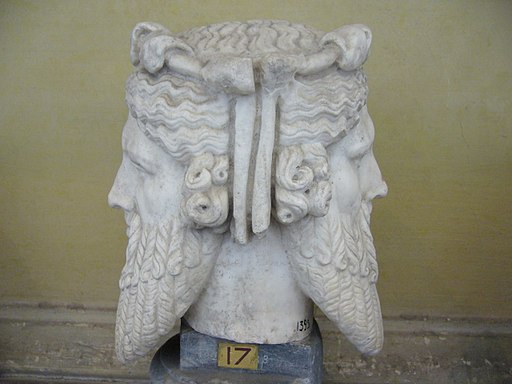
In a planetary sense, JANUARY belongs to Saturn. In a mythological sense, JANUARY belongs to Janus.

Saturn governs time, structure, discipline, and learning. Saturn rewards us when we do what we need to do.

Janus is the two headed Roman god that represented a doorway, gateway or threshold. In deeper texts, he is said to be the gateway between Heaven and Earth. Looking in one direction he observes the past, while looking in the other direction he observes the future. He can only see either from the now.

Some people believe January is named for Juno, Roman protector goddess of the state and daughter of Saturn. Most people believe January was named for Janus.

As a reader and author, I'm very drawn to time travel novels. Perhaps it's a form of escapism that helps me move through the past, present and future with equal delight. 

While I don't do new year's resolutions anymore, I've concluded that in 2015 I spent too much time recalling the past and projecting the future, and not enough time shaping my daily life. Just the awareness of this is helping me to shift and live in the moment more. 

The now can be a very magical place!

Take this moment to analyze your pattern. Please share if you’d like to.

Percentage of time I spend in the:

Past
Present
Future

If you are a writer, do you see how living in the now could help you be more productive in moving your career forward?

Thanks for stopping by today. May you thoroughly enjoy your journey through 2016.

GEMMA JULIANA writes all kinds of love stories, from contemporary to paranormal. She has a penchant for romantic international settings. Gemma lives in a cozy cottage in Texas with her very own hero, teen son, and a dog who rules them all. Chocolate and coffee nourish her muse and fuel her creativity. She loves hearing from readers.

amazon.com/author/gemmajuliana


Monday, January 12, 2015

DAYS, MONTHS AND TIMELINES


For my first blog post of 2015, let’s review some mythology surrounding the days and months of the year, and the history of calendars.  Initially this theme caught my interest while doing some research for a paranormal story.

The ancient people expressed their reverence for nature and the unseen forces in many ways, and never missed an opportunity to honor their gods and goddesses. 

 Thor's Fight With The Giants by Marten Eskil Winge

The seven days of the week were named as follows:

Monday - Moon Day
Tuesday - Mars Day
Wednesday - Mercury Day (Woden, Odin, chief god the Norse pantheon)
Thursday - Jupiter Day (the equivalent of Thor, god of thunder in the Norse pantheon)
Friday - Venus Day (equal to Freyja, goddess of creativity and sexuality in the Norse pantheon)
Saturday - Saturn Day
Sunday - Sun Day 


JANUARY – JANUS was a very unique god. He could look backwards and forwards at the same time. Have you ever heard the saying, “eyes in the back of your head”? Janus did one better than that – with an entire face. Which face looks backwards and which one looks forwards? Perhaps he is a reminder of linear time, and that on planet earth, the past, present and future are just one long time line. Janus may be reminding us not to forget what has happened in our past as we prepare in the now for the future. 

Head of Janus, Vatican Museum, Rome - Author: Loudon Dodd

The naming of the months of the year in the Julian calendar, which was introduced by Julius Caesar in 46 BC, is explained as follows:

January: Janus, the Roman god of doors and gates, beginnings and endings. It represents the unique energy of closing out the old and bringing in the new. (Januarius). Numa Pompilius added this month and it became the new first month of the year instead of the eleventh.
February: Februa or Februalia. Around 690 BC Numa Pompilius set this period at the end of the year in ancient Rome as a time of festivals and public gatherings for purification and repenting, when sacrifices were offered to atone for sins. The name comes either from there, or from the old Etruscan god of the underworld and purification, Februus. This was his sacred month.
March: Mars, god of war, was the namesake of this, the first month of the Roman year.
April: Aprilis, aperire, the Latin verb meaning “to open” (as in nature’s spring buds).
May: Maia, goddess of plant and vegetation growth, or Maiestra, goddess of reverence and honor. This was the third month of the Roman year. She was the wife of the god Vulcan.
June: junius, the Latin for the goddess Juno, known as queen of the gods.
July: Julius Caesar was born in this month, and it was named after him when he was assassinated in 44 B.C. Originally this month was called Quintilis (fifth month).
August: Named for the first Roman emperor, Augustus Caesar, in 8 B.C. because many fortunate events happened for him during this month which was previously called Sextilis.
September: septem, Latin for “seven” as the seventh month.
October: from octo, Latin for “eight” as the eighth month.
November: from novem, Latin for “nine” as the ninth month.
December: from decem, Latin for “ten” for the tenth month.

 
Freyja and Heimdall Who Returns Her Amber Necklace Brisingamen

The main reason given for changing from the Julian calendar to the Gregorian calendar was to change the date of Easter, since the Julian calendar contained an 11 minute per year error.

Pope Gregory of the Catholic Church rearranged the calendar in 1582. His creation became known as the Gregorian calendar. January 1st became the first day of the new year. Most western nations celebrated it, although previously the first day of the new year was in March. Many Protestant and non-Catholic nations were suspicious of his motives, and held out as long as possible. Germany, for example, finally gave in and adopted the new calendar in 1610. Turkey was the last to change over, in the year 1926/27. 

Britain and the American colonies did not convert to the Gregorian calendar until 1752. Up to then they celebrated the new year at the spring equinox on March 21st. Eleven days were removed by British Parliament from the old calendar – September 3 through September 13, 1752  ceased to exist – in order to move into alignment with western Europe. Russia resisted adopting the Gregorian calendar until after the Revolution in 1917. 

Our Gregorian calendar also has a flaw, if less extreme. There is a discrepancy of 26 seconds per year with the solar year, despite Lilius’ best attempt at synching the new calendar with the seasons. Since Pope Gregory introduced the Gregorian calendar in 1582, several hours of time difference has already accumulated. It is said that by the year 4909 our current Gregorian calendar will be off from the solar year by one full day.

The love affairs of the gods and goddesses often seemed more driven by lust and dominance than by romance. One ‘tidbit’ about Janus made my eyes widen, but by now I should be used to the violent self-expression of the gods. It is said that Janus raped Crane Grane or Carna, the nymph of the sacred wood of Helernus, and then elevated her to become goddess of hinges, Cardea. 

Might this equate to the old ‘power behind the throne’ theory? After all, as god of gates and doors, where would he be without a hinge?


GEMMA JULIANA is a multi-published author who lives in an enchanted cottage in north Texas with her handsome hero, teen son and a comical dog. She loves making new friends and hearing from readers. Exotic coffee and chocolate fuel her creativity. You can buy Gemma’s books on Amazon and visit her website http://www.gemmajuliana.com or follow on Twitter @Gemma_Juliana: https://twitter.com/gemma_juliana


Share buttons