
All blogs are property of authors and copying is not permitted.

Click image to one-click your copy of Soldiers of Fortune

CLICK BELOW & SUBSCRIBE TO THE RB4U NEWSLETTER

Showing posts with label tequila. Show all posts

Wednesday, July 24, 2019

History of Tequila


Today, July 24, is National Tequila Day. Sounds fun, right? Back in the day, I drank my share of tequila, with salt and lemon. As a nod to my younger days, I thought I’d research the history of tequila.

Tequila is the name for a distilled beverage made from the blue agave plant, primarily in the area surrounding the city of Tequila, 40 miles northwest of Guadalajara, Mexico. The red volcanic soil in the surrounding region is particularly well-suited to the growing of the blue agave plant. (Wikipedia)

Mezcal wine, tequila’s grandparent, was first produced only a few decades after the Spaniards came to the New World in 1521. Agave played a much larger role than the source of an alcoholic drink. Its leaves were used for a hemp-like fiber to make mats, clothing, rope and paper. It was also the source of the nutrient and vitamin-rich brew, pulque. (Source: Los Cabos Magazine)

The distillation of pulque into something stronger may have originated by the Conquistadors as early as the 1520s. You’re familiar with Cuervo Tequila. Jose Antonio Cuervo was the first licensed manufacturer of tequila. In 1758, the King of Spain gave Cuervo the rights to cultivate a parcel of land in Mexico. Today, Cuervo is the largest manufacturer of tequila in the world. (Source: Los Cabos Magazine)
Mexican laws state that tequila can only be produced in the state of Jalisco and limited municipalities in the states of Guanajuato, Michoacán, Nayarit, and Tamaulipas. Planting, tending, and harvesting the agave plant remains a manual effort, largely unchanged by modern farm machinery and relying on centuries-old know-how.
The men who harvest it, the jimadores [ximaˈðoɾes], have intimate knowledge of how the plants should be cultivated, passed down from generation to generation. (Wikipedia)

"Tequila worm" misconception

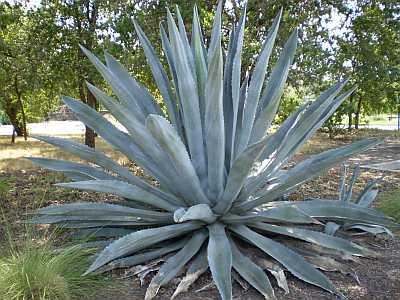
A young agave plant
THE WORM
Another interesting error is an urban legend related to a worm. The worm-in-the-bottle myth is old and tired. The truth has been broadcast and expounded for years by the cognoscenti of tequila, in newspapers, magazines and on the internet. Yes, it’s true, some American-bottled brands put one in their bottle to impress the gringos and boost sales, but it was a marketing ploy developed in the 1940s, not a Mexican tradition.

Sometimes however, there is a worm, properly a butterfly caterpillar, in some types of 
mezcal. You may also get a small bag of worm salt and chile powder tied to a mezcal bottle. There are two types of worms in mezcal: the red, gusano rojo—considered superior because it lives in the root and heart of the maguey—and the less-prized white or gold gusano de oro, which lives on the leaves. The red gusano turns pale in the mezcal, the gold turns ashen-gray. Both larvae are commonly eaten as food and are sold in Zapotec markets.

Yes, you’re supposed to eat the worm in mezcal. Don’t worry: it’s quite well pickled and free of pesticides (they’re often raised just for use in mezcal, cooked and pickled in alcohol for a year). But dispel any idea it has any magical or psychotropic properties, that it’s an aphrodisiac or the key to an "unseen world." It’s merely protein and alcohol—but it’s very rich in imagery. Note: Yuck.
In Mexico, the most traditional way to drink tequila is neat, without lime and salt. Outside Mexico, a single shot of tequila is often served with salt and a slice of lime. This is called tequila cruda and is sometimes referred to as "training wheels", "lick-sip-suck", or "lick-shoot-suck" (referring to the way in which the combination of ingredients is imbibed). The drinkers moisten the back of their hands below the index finger (usually by licking) and pour on the salt. Then the salt is licked off the hand, the tequila is drunk, and the fruit slice is quickly bitten. Groups of drinkers often do this simultaneously. (Wikipedia)
Note: I always thought you used lemon. That’s what we did in bars in the summer of 1971 at the Jersey Shore. Good times.

Now that you know all the important facts about tequila, go out and celebrate National Tequila Day.

While drinking your tequila, settle down with a sizzling, fun romance.

SALE!!


A Groom for Christmas (Love On a Dare Book 1)
Only 99 cents for a very limited time.

Fun holiday read.

A GROOM FOR CHRISTMAS is a new twist on the classic Hallmark Christmas movie full of family, humor, love, and a little bit of redemption.

Family pressure just might make her do something crazy...

When a young woman hires her hometown’s former bad boy to be her pretend fiancé for the holidays, she finds she can’t wrap up her feelings as easily as a Christmas gift.

New York jewelry designer Graceann Palmer has two days to find a fiancé to bring home to Pennsylvania for the holidays so her matchmaking mama will quit fixing her up with jerks. The Falcon, a motorcycle-riding, leather-clad former high school crush, helped her out once before. Maybe he'll do it again.

Jake Falco, man of many mysteries, is back in town on a mission—one the people of Spirit Lake most likely won't appreciate. When Graceann presents him with her crazy scheme, it gives him something he's always wanted—a chance to get to know Graceann. It also gives him the perfect opportunity to add fuel to his project of revenge. 

But as Jake and Graceann grow closer, their engagement-of-convenience begins to feel like the real deal—until Jake’s secrets are revealed. 

Can a relationship that began with lies and secrets bloom like a rare Christmas rose into happily-ever-after?

2013 Snow Globes Award Contest Finalist
Winner! 2014 New Jersey Romance Writers Golden Leaf Award
2014 Readers' Choice Nominee, Best Couple, Love Romances Cafe
2014 RomCon Awards Finalist

There’s no tequila in A Groom for Christmas, but the sequel, Wedded on a Dare (Love On a Dare Book 2) is out, and I have scene where the heroine and hero are drinking tequila. Let’s hear it for tequila!

Here’s what some Amazon reviewers have said about A Groom for Christmas.
…“The story grabbed me in the beginning and kept me interested to the end. I urge you to read Jake and Graceann's story.”

…”A fun warm sweet romance that will have you laugh and see that you can't judge a person by who they were for you may miss something wonderful.”

A trip to Vegas...
A gorgeous man...
A beautiful woman...
What could go wrong?

When a struggling actress takes a role as the glamorous temporary wife of a wealthy playboy, she finds love doesn’t always come on cue.




Tuesday, July 24, 2018

History of Tequila


Today, July 24, is National Tequila Day. Sounds fun, right? Back in the day, I drank my share of tequila, with salt and lemon.  As a nod to my younger days, I thought I’d research the history of tequila.

Tequila is the name for a distilled beverage made from the blue agave plant, primarily in the area surrounding the city of Tequila, 40 miles northwest of Guadalajara. The red volcanic soil in the surrounding region is particularly well-suited to the growing of the blue agave plant. (Wikipedia)

Mezcal wine, tequila’s grandparent, was first produced only a few decades after the Spaniards came to the New World in 1521. Agave played a much larger role than the source of an alcoholic drink. Its leaves were used for a hemp-like fiber to make mats, clothing, rope and paper. It was also the source of the nutrient and vitamin-rich brew, pulque. (Source: Los Cabos Magazine)

The distillation of pulque into something stronger may have originated by the Conquistadors as early as the 1520s. You’re all familiar with Cuervo Tequila. Jose Antonio Cuervo was the first licensed manufacturer of tequila. He received the rights to cultivate a parcel of land from the King of Spain in 1758. Today, Cuervo is the largest manufacturer of tequila in the world. (Source: Los Cabos Magazine)
Mexican laws state that tequila can only be produced in the state of Jalisco and limited municipalities in the states of Guanajuato, Michoacán, Nayarit, and Tamaulipas. Planting, tending, and harvesting the agave plant remains a manual effort, largely unchanged by modern farm machinery and relying on centuries-old know-how.
The men who harvest it, the jimadores [ximaˈðoɾes], have intimate knowledge of how the plants should be cultivated, passed down from generation to generation. (Wikipedia)

"Tequila worm" misconception
A young agave plant


THE WORM
Another interesting error is an urban legend related to a worm. The worm-in-the-bottle myth is old and tired. The truth has been broadcast and expounded for years by the cognoscenti of tequila, in newspapers, magazines and on the internet. Yes, it’s true, some American-bottled brands put one in their bottle to impress the gringos and boost sales, but it was a marketing ploy developed in the 1940s, not a Mexican tradition.

Sometimes however, there is a worm, properly a butterfly caterpillar, in some types of 
mezcal. You may also get a small bag of worm salt and chile powder tied to a mezcal bottle. There are two types of worms in mezcal: the red, gusano rojo—considered superior because it lives in the root and heart of the maguey—and the less-prized white or gold gusano de oro, which lives on the leaves. The red gusano turns pale in the mezcal, the gold turns ashen-gray. Both larvae are commonly eaten as food and are sold in Zapotec markets.

Yes, you’re supposed to eat the worm in mezcal. Don’t worry: it’s quite well pickled and free of pesticides (they’re often raised just for use in mezcal, cooked and pickled in alcohol for a year). But dispel any idea it has any magical or psychotropic properties, that it’s an aphrodisiac or the key to an "unseen world." It’s merely protein and alcohol—but it’s very rich in imagery. Note: Yuck.
In Mexico, the most traditional way to drink tequila is neat, without lime and salt. Outside Mexico, a single shot of tequila is often served with salt and a slice of lime. This is called tequila cruda and is sometimes referred to as "training wheels", "lick-sip-suck", or "lick-shoot-suck" (referring to the way in which the combination of ingredients is imbibed). The drinkers moisten the back of their hands below the index finger (usually by licking) and pour on the salt. Then the salt is licked off the hand, the tequila is drunk, and the fruit slice is quickly bitten. Groups of drinkers often do this simultaneously. (Wikipedia)
Note: I always thought you used lemon. That’s what we did. We used to drink it this way in groups in a bar, mostly the summer of 1971, at the Jersey Shore.


Now that you know all the important facts about tequila, go out and celebrate National Tequila Day.

While drinking your tequila, settle down with a sizzling, fun romance.

SALE!!
A Groom for Christmas
Only 99 cents for a very limited time.


Fun holiday read.

A GROOM FOR CHRISTMAS is a new twist on the classic Hallmark Christmas movie full of family, humor, love, and a little bit of redemption.

Family pressure just might make her do something crazy...

When a young woman hires her hometown’s former bad boy to be her pretend fiancé for the holidays, she finds she can’t wrap up her feelings as easily as a Christmas gift.

New York jewelry designer Graceann Palmer has two days to find a fiancé to bring home to Pennsylvania for the holidays so her matchmaking mama will quit fixing her up with jerks. The Falcon, a motorcycle-riding, leather-clad former high school crush, helped her out once before. Maybe he'll do it again.

Jake Falco, man of many mysteries, is back in town on a mission—one the people of Spirit Lake most likely won't appreciate. When Graceann presents him with her crazy scheme, it gives him something he's always wanted—a chance to get to know Graceann. It also gives him the perfect opportunity to add fuel to his project of revenge. 

But as Jake and Graceann grow closer, their engagement-of-convenience begins to feel like the real deal—until Jake’s secrets are revealed. 

Can a relationship that began with lies and secrets bloom like a rare Christmas rose into happily-ever-after?

2013 Snow Globes Award Contest Finalist
Winner! 2014 New Jersey Romance Writers Golden Leaf Award
2014 Readers' Choice Nominee, Best Couple, Love Romances Cafe
2014 RomCon Awards Finalist

There’s no tequila in A Groom for Christmas, but I’m now writing the sequel, Wedded on a Dare, and I have scene where the heroine and hero are drinking tequila. Let’s hear it for tequila!

Here’s what some Amazon reviewers have said about A Groom for Christmas.
…“The story grabbed me in the beginning and kept me interested to the end. I urge you to read Jake and Graceann's story.
…”A fun warm sweet romance that will have you laugh and see that you can't judge a person by who they were for you may miss something wonderful.


Monday, July 24, 2017

History of Tequila


History of Tequila


Today, July 24, is National Tequila Day. Sounds fun, right? Back in the day, I drank my share of tequila, with salt and lemon.  As a nod to my younger days, I thought I’d research the history of tequila.

Tequila is the name for a distilled beverage made from the blue agave plant, primarily in the area surrounding the city of Tequila, 40 miles northwest of Guadalajara. The red volcanic soil in the surrounding region is particularly well-suited to the growing of the blue agave plant. (Wikipedia)

Mezcal wine, tequila’s grandparent, was first produced only a few decades after the Spaniards came to the New World in 1521. Agave played a much larger role than the source of an alcoholic drink. Its leaves were used for a hemp-like fiber to make mats, clothing, rope and paper. It was also the source of the nutrient and vitamin-rich brew, pulque. (Source: Los Cabos Magazine)

The distillation of pulque into something stronger may have originated by the Conquistadors as early as the 1520s. You’re all familiar with Cuervo Tequila. Jose Antonio Cuervo was the first licensed manufacturer of tequila. He received the rights to cultivate a parcel of land from the King of Spain in 1758. Today, Cuervo is the largest manufacturer of tequila in the world. (Source: Los Cabos Magazine)
Mexican laws state that tequila can only be produced in the state of Jalisco and limited municipalities in the states of Guanajuato, Michoacán, Nayarit, and Tamaulipas. Planting, tending, and harvesting the agave plant remains a manual effort, largely unchanged by modern farm machinery and relying on centuries-old know-how.
The men who harvest it, the jimadores [ximaˈðoɾes], have intimate knowledge of how the plants should be cultivated, passed down from generation to generation. (Wikipedia)

"Tequila worm" misconception


A young agave plant

THE WORM
Another interesting error is an urban legend related to a worm. The worm-in-the-bottle myth is old and tired. The truth has been broadcast and expounded for years by the cognoscenti of tequila, in newspapers, magazines and on the internet. Yes, it’s true, some American-bottled brands put one in their bottle to impress the gringos and boost sales, but it was a marketing ploy developed in the 1940s, not a Mexican tradition.

Sometimes however, there is a worm, properly a butterfly caterpillar, in some types of mezcal. You may also get a small bag of worm salt and chile powder tied to a mezcal bottle. There are two types of worms in mezcal: the red, gusano rojo—considered superior because it lives in the root and heart of the maguey—and the less-prized white or gold gusano de oro, which lives on the leaves. The red gusano turns pale in the mezcal, the gold turns ashen-gray. Both larvae are commonly eaten as food and are sold in Zapotec markets.

Yes, you’re supposed to eat the worm in mezcal. Don’t worry: it’s quite well pickled and free of pesticides (they’re often raised just for use in mezcal, cooked and pickled in alcohol for a year). But dispel any idea it has any magical or psychotropic properties, that it’s an aphrodisiac or the key to an "unseen world." It’s merely protein and alcohol—but it’s very rich in imagery. Note: Yuck.
In Mexico, the most traditional way to drink tequila is neat, without lime and salt. Outside Mexico, a single shot of tequila is often served with salt and a slice of lime. This is called tequila cruda and is sometimes referred to as "training wheels", "lick-sip-suck", or "lick-shoot-suck" (referring to the way in which the combination of ingredients is imbibed). The drinkers moisten the back of their hands below the index finger (usually by licking) and pour on the salt. Then the salt is licked off the hand, the tequila is drunk, and the fruit slice is quickly bitten. Groups of drinkers often do this simultaneously. (Wikipedia)
Note: I always thought you used lemon. That’s what we did. We used to drink it this way in groups in a bar, mostly the summer of 1971, at the Jersey Shore.

Now that you know all the important facts about tequila, go out and celebrate National Tequila Day.

Since this is summer and many of us go to the shore or the beach (We say Shore for New Jersey, Beach for the Delaware beaches), I have a sweet story set the Jersey Shore.

Loving Or Nothing 


2012 Gulf States Silken Sands Star Contest Third Place Winner
2012 Best Indie Book Award Semi-Finalist

When a ruthless developer and a sentimental bridal shop owner clash, sparks fly. 

No stranger to loss, Tami Morrelle is holding on with one satiny thread to the only thing she has left that ties her to her loved ones – the family bridal shop.

Local bad boy Daniel Ramsey is back in town and on a mission – to turn Tami’s world upside down – any way he can.

Daniel needs Tami’s beachfront home and business to complete his crowning achievement as a successful developer. His latest proposal hinges on buying former high school classmate Tami’s land to make it happen. More importantly, it will show those in Loving who were convinced he’d amount to less than nothing they were dead wrong about him.

For Daniel, it’s Loving or nothing. For Tami, selling out to Daniel will leave her with nothing. But when the ruthless developer and sentimental bridal shop owner clash, sparks fly. 

A secret crush. Two wounded hearts. Will Daniel and Tami be willing to give up what they think they need and open their hearts to what really matters in Loving?

(Includes bonus short story, "Accidental Love.")


Sunday, July 24, 2016

Everything You Wanted To Know About Tequila But Were Afraid To Ask


Today, July 24, is National Tequila Day. Sounds fun, right? Back in the day, I drank my share of tequila, with salt and lemon.  As a nod to my younger days, I thought I’d research the history of tequila.

Tequila is the name for a distilled beverage made from the blue agave plant, primarily in the area surrounding the city of Tequila, 40 miles northwest of Guadalajara. The red volcanic soil in the surrounding region is particularly well-suited to the growing of the blue agave plant. (Wikipedia)

Mezcal wine, tequila’s grandparent, was first produced only a few decades after the Spaniards came to the New World in 1521. Agave played a much larger role than the source of an alcoholic drink. Its leaves were used for a hemp-like fiber to make mats, clothing, rope and paper. It was also the source of the nutrient and vitamin-rich brew, pulque. (Source: Los Cabos Magazine)

The distillation of pulque into something stronger may have originated by the Conquistadors as early as the 1520s. You’re all familiar with Cuervo Tequila. Jose Antonio Cuervo was the first licensed manufacturer of tequila. He received the rights to cultivate a parcel of land from the King of Spain in 1758. Today, Cuervo is the largest manufacturer of tequila in the world. (Source: Los Cabos Magazine)


Mexican laws state that tequila can only be produced in the state of Jalisco and limited municipalities in the states of Guanajuato, Michoacán, Nayarit, and Tamaulipas. Planting, tending, and harvesting the agave plant remains a manual effort, largely unchanged by modern farm machinery and relying on centuries-old know-how.
The men who harvest it, the jimadores [ximaˈðoɾes], have intimate knowledge of how the plants should be cultivated, passed down from generation to generation. (Wikipedia)

"Tequila worm" misconception


A young agave plant
THE WORM
Another interesting error is an urban legend related to a worm. The worm-in-the-bottle myth is old and tired. The truth has been broadcast and expounded for years by the cognoscenti of tequila, in newspapers, magazines and on the internet. Yes, it’s true, some American-bottled brands put one in their bottle to impress the gringos and boost sales, but it was a marketing ploy developed in the 1940s, not a Mexican tradition.

Sometimes however, there is a worm, properly a butterfly caterpillar, in some types of mezcal. You may also get a small bag of worm salt and chile powder tied to a mezcal bottle. There are two types of worms in mezcal: the red, gusano rojo—considered superior because it lives in the root and heart of the maguey—and the less-prized white or gold gusano de oro, which lives on the leaves. The red gusano turns pale in the mezcal, the gold turns ashen-gray. Both larvae are commonly eaten as food and are sold in Zapotec markets.

Yes, you’re supposed to eat the worm in mezcal. Don’t worry: it’s quite well pickled and free of pesticides (they’re often raised just for use in mezcal, cooked and pickled in alcohol for a year). But dispel any idea it has any magical or psychotropic properties, that it’s an aphrodisiac or the key to an "unseen world." It’s merely protein and alcohol—but it’s very rich in imagery. Note: Yuck.
In Mexico, the most traditional way to drink tequila is neat, without lime and salt. Outside Mexico, a single shot of tequila is often served with salt and a slice of lime. This is called tequila cruda and is sometimes referred to as "training wheels", "lick-sip-suck", or "lick-shoot-suck" (referring to the way in which the combination of ingredients is imbibed). The drinkers moisten the back of their hands below the index finger (usually by licking) and pour on the salt. Then the salt is licked off the hand, the tequila is drunk, and the fruit slice is quickly bitten. Groups of drinkers often do this simultaneously. (Wikipedia)
Note: I always thought you used lemon. That’s what we did. We used to drink it this way in groups in a bar, mostly the summer of 1971, at the Jersey Shore.

Now that you know all the important facts about tequila, go out and celebrate National Tequila Day.

While we’re on the subject of celebrating, I’m celebrating the release of Letterbox Love Stories, Volume 1. This anthology of romances from nine authors all over the Globe has stories that span the centuries, something for every reading taste. I’m proud to be in this set. I’ve read all the stories, and they’re fabulous. It’s on sale now for a special introductory price of only 99 cents. Get your copy today!

What if a life-changing letter arrived in today's mail? Now imagine it leads to love and adventure! From the northern British Isles, across the mainland of Europe, and on to Turkey, nine international Award-winning and Multi-published Romance Authors share spellbinding love stories told across time. This collection includes contemporary, historical and futuristic time travel romances touched by magic. And each begins with a letter... 


 Come visit me at: www.caramarsi.com
http://www.amazon.com/Cara-Marsi


Share buttons