All blogs are property of authors and copying is not permitted.

Click image to one-click your copy of Soldiers of Fortune

CLICK BELOW & SUBSCRIBE TO THE RB4U NEWSLETTER

Showing posts with label romance novels. Show all posts

Wednesday, October 18, 2023

Reading Romance: Expectations vs Reality

Once upon a time, romance readers were shamed for reading the genre. Readers concealed the covers and most importantly, hid their love for the most popular-selling genre. The books were called bodice rippers (for the rape trope that populated many novels) or trashy books.  New York Times refused to review the books. Such treatment is changing. New readers are finding their way to the romance section of the bookstore. Yet, the exceptions and reality must still be confronted. 

A romance novel expectation is that the books are nothing but smut. The genre features many sensual levels. There is clean romance or sweet romance where the bedroom door is firmly shut and locked to the spiciest of reads. Yet whatever the sexual level, this genre is about romance, love, and overcoming conflicts for the characters to obtain their happily ever after. 


Another expectation of the romance genre is that it is nothing more than three hundred-plus pages of mindless fluff since it deals with love and relationships. But that notion has no basis in reality. The romance genre, whatever the sub-genre, deals with all the modern issues we struggle against. Books now feature heroes and heroines living with mental health or medical issues such as being neurodivergent, being on the spectrum, or having a chronic illness. The world-building of romances are no longer all white but feature and highlight the true variety of the human species and our cultures. And the external conflict deals with sexism, racism, and all the isms that blight the world. 


 Romance novels continue to evolve and develop just like the real world and reflect our world in its pages. Please share the title and author of your favorite romance and the reason for it. 

Thursday, November 18, 2021

12 Easy Steps To Intimacy In A R romance Novel

 A tool in the romance author’s box is the 12 Steps to Intimacy. These steps happen between your hero and heroine (I’m using hero and heroine to simply the explanation of each stage) as discovered by Desmond Morris. These stages happen in the natural world and every attraction you had in your life. It happens even without our awareness and each step cannot be missed. 


1. Eye To Body:

Think about the movies. When the sexy heroine or hero first appears, the camera pans from the legs to hips, and up the chest, finally reaching the head. The idiom is beauty is in the eye of the beholder. As the beholder, we are experiencing the first stage (hopefully, so is the other character)—the physical attraction stage, or as I call it the damn, he’s hot step.


2. Eye to Eye: 

The second step is the first awareness between the hero and heroine. The spark of attraction grows hotter or fizzles. This is wherein a novel or real life, we notice details about his eyes. We might see a glint or feel cold or afraid and all from a glance (think how you feel when you first met the eyes of the person you love or the first time you saw that Charles Mason photo with his crazy eyes). 


3. Voice to Voice:

Or the Now, we’re talking stage. That’s what I call this one. The hero and heroine are physically close, most likely an arm’s length away so that they can carry on a conversation. Screaming across a room isn’t very romantic. The dialogue—what is said, how it’s spoken, and the sound of the voice. These details reinforce the intimacy. Think about after you’ve talked with someone, you feel as if you know them better. It happens at this stage. 


4.  Hand to Hand:

Have you sat at a bar, talking with a guy and you place your hand atop of his? The first physical touch and the attraction can build and in romance, it’s a must. This step reveals the beginning intimacy between the couple and helps draw them closer, emotionally. Think about that scene in Bridgerton when Daphne and Simon touch hands. You felt the attraction and intimacy in that simple act because you unconsciously understand its meaning. 


5. Arm to Shoulder: 

This step has more unconscious risk than the others. This touch places hands near areas of danger on your body—neck, and head. With this stage, a person could be drawn in for a hug or the hand placed on the back. It’s a level of intimacy not enjoyed by everyone in your life. Imagine if your boss placed his hand on your shoulder. You’d more likely feel uncomfortable maybe violate, having your space invaded and you may even think why are you touching me? 


6. Arm to Waist: 

This act of intimacy happens between people very close to each other. In a novel, desire is boiling, and the bond has strengthened. All who witness this physical act know the meaning of such a touch. Imagine if you spotted your partner with his hand on a woman’s waist. 


7. Mouth to Mouth:

There is nothing like a kiss. Scientists have stated that the chemicals of the saliva exchanged during a kiss have a way of letting our bodies know if the person is a good mate—biologically, at least. A bad kiss can ruin a good start to a developing relationship. We don’t go around kissing people, especially after Covid. Even kisses on the cheek have an attachment. 


8. Hand to Head:

Unconsciously, this is the most physically dangerous touch, which remains from our less evolved days. We are at risk when someone touches our heads. With this step, you must have an intimacy with the other person, knowing that no harm comes from that person. 


9. Hand to Body: 

    This stage can be half a love scene since this is a truly intimate act and the beginning before our hero and heroine enter the bedroom. Here, the body is explored in an amorous way. With the hand-to-body step, intimacy is almost at its apex and perhaps, love has bloomed even if unaware of it. If the next step is to happen, then this is where the couple has to decide to go forward together and toward the next one.


10. Mouth to Breast:

This stage is part of a half love scene as well as the beginning of a love scene. This stage is another actual physical intimate act. Emotions are involved.


11. Hand to Genitals:

   Another step in the half love scene or the middle of a love scene. Genitals are private, our own personal place that is not revealed easily. Think about how awkward GYN appointments are. This is an extremely intimate act, which will only build, at least in romance novels. 


12. Genitals to Genitals:

     S-E-X. The final step of these stages and the end of a love scene. There is trust, desire, and intimacy between the couple. 


But that doesn’t mean the book is over. These twelve stages will reinforce the growing romance between your couple. Best of all, you can mix up these stages. You do not have to countdown each one. If you do put—let’s say—hand to hand before voice to voice, just remember how your character would react in that situation. If she doesn’t like to be touched, then she’s going to pull her hand free. 


Or what if your hero and heroine have sex in the opening scene. That is a purely physical act but intimacy between the two is lacking so this couple will have to build intimacy with these steps. 


So, play with these stages and have fun. Then write them again. 

Wednesday, August 18, 2021

Top Ten Books For Writing A Romance Novel


Have you ever thought about writing a romance? Don't know where to begin or perhaps, you are in need of some guidance. Here is a top ten list to get you started.

  1. Romancing the Beat: Story Structure for Romance Novels by Gwen Hayes
  2. Romance Tropes and Hooks by Karen Winter
  3. Break into Fiction by Mary Buckham
  4. Writing the Alpha Male by Karen Winter
  5. Write Naked by Jennifer Probst
  6. Finding Your Writer’s Voice by Bria Quinlan and Jeannie Lin
  7. Character Arcs by Jordan McCollum
  8. Practical Emotional Structure by Jodi Henley
  9. The Joy of Writing Sex: A Guide for Fiction Writers by Elizabeth Benedict
  10. The Art of Character by David Corbett

Monday, January 18, 2021

It's The Most Comfortable Time of the Year


New’s Year is over. The resolutions have probably been broken. Valentine’s Day is some weeks away  (that’s if you have someone to celebrate the holiday with), and winter has fallen over the Northern hemisphere so there is nothing else to do but settle at the home and find some comfort. 


A natural association with comfort is comfort foods. Though hot chocolate or mac and cheese may be the thoughts that come to mind, I speaking about comfort books and TV shows. 


For me, I love reading those romance novels that still warm my heart, entertain me with a laugh, and romance. Lately, I have been re-reading Julie Garwood and Julia Quinn (thanks to the Bridgerton series on Netflix that reminded me how much I love the series and the author). As for TV, I’m watching my favorites The Big Bang Theory and Family Guy. 


These favorites of mine just seem to make me melt into my favorite chair or into my mattress and burrow under the blanket. All the stress slips away and my thoughts stop. We all need some comfort especially after the times we have experienced. This is the perfect time of year to seek out that comfort even if it’s fifteen minutes. The mind and body need to recharge so we can face the tasks of daily life. 


Some might call it self-care. That might put some people off so I call it comfort. So, what are your comforts? Is it reading your favorite books? Seeing your favorite TV shows or movies? Or something entirely different? Where do you find your comfort?


Monday, April 24, 2017

History of the Romance Novel


We’re all romance readers here, right? Did you ever wonder about their history? It might surprise you.

The story is as old as time: Boy meets girl, boy loses girl. Against all adversity, the couple finds their way to happy-ever-after. This is the description of all romance novels pared down to their essence.

The readership for the romance genre continues to expand. Romance is the highest selling fiction. According to Romance Writers of America, the total annual sales value of romance in 2013, the latest date available, was $1.08 billion. The romance novel share of the total fiction market is 34%. Eighty-four percent of romance book buyers are female, with an average age of between 30-44 years.

Romance is in our DNA. I wondered how long romance novels have been around. A long time, it turns out. With a little research I found this: Scholars cite Samuel Richardson’s Pamela, or Virtue Rewarded as the first modern romance novel. The story of a teenage maidservant courted by her landowner master, it was enormously popular when it was first published in 1740. Sound familiar? Young virginal girl, wealthy, older man.

While Pamela wasn’t the first novel about a romantic relationship, it was the first to be presented from the heroine’s point of view. The novel’s happy ending was also unique for the time.
Then, of course, there’s Jane Austen, beloved and revered by legions of romance authors and readers. I’m sure most of you Austen fans know this, but when Sense and Sensibility was published in 1811, Austen couldn’t use her name as the author. The cover said only that it had been written “by a lady.” Writing a novel, especially one about relationships, was considered unseemly for someone of Austen’s upbringing. (We’ve come a long way, baby).
Austen paid to publish Sense and Sensibility herself, paying roughly one-third of her yearly income to publish 750 copies. Austen was an indie author! All copies sold out and she did a second printing. Yay, Jane! Austen’s beloved novels have inspired modern retellings like Helen Fielding’s Bridget Jones’s Diary and Seth Graham-Smith’s parody Pride and Prejudice and Zombies.
Austen’s novels are unique because they are some of the very few romance novels considered “literary.” Unfortunately, romance novels have gotten a bad rap by people who don’t know them or read them and have judged them “trashy” or “bodice rippers.” Some of the criticism is misogynist as most romance readers are women. The novels have this bad reputation despite the fact that 75% of romance readers hold college degrees, with 39% holding advanced degrees. A very substantial number of romance authors hold degrees.
Harlequin, the publishing giant, has been around since the 1930’s. Their original covers were plain brown wrappers. In the 1970’s, in an effort to increase sales, Harlequin began stocking their books on supermarket and drugstore shelves. They also sponsored giveaways, putting their books inside boxes of sanitary napkins, cosmetics, and household cleaners. Their ideas paid off, and sales took off, both for Harlequin and for romance novels.
There are many sub-genres of romance, such as: romantic suspense, erotic romance, gay romance. According to the Romance Writers of America, to be a romance, a book must focus on a central love story and have “an emotionally satisfying and optimistic ending.”
Now, of course, we have ebooks and indie publishing, and the romance market is evolving again. Romance novels have often been on The New York Times bestsellers list. Don’t expect to see romance novels reviewed in that newspaper though. Even the reigning queen of romance, Nora Roberts, has only had two of her books reviewed in The New York Times.
There you have it, a capsule history of romance novels. The romance genre is here to stay and will only get better and stronger. Because who doesn’t love a good love story?
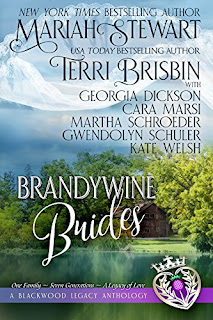
I'm proud and happy to announce the release of Brandywine Brides: A Blackwood Legacy Anthology. Available for pre-order now at the special price of 99 cents. Release is tomorrow, April 25.
We authors are friends who've met monthly for lunch for the last several years. We call ourselves The Writers Who Lunch. We decided to do an anthology together with stories set in our local area. I'm totally thrilled to be in a set with these talented women.

BRANDYWINE Brides ~ A Blackwood Legacy Anthology
One Family – Seven Generations – A Legacy of Love

Almost three centuries ago, a Scottish convict was sold into indentured servitude in Philadelphia and given a second chance at a life far from the country of his birth. In the years since, the farm secured by Finlan Blackwood’s efforts would grow and thrive in the Brandywine River valley just as his family and descendants did. Today, Blackwood Farm is one of the largest and most successful farms in Chester County. But it took the sacrifices and best efforts of each generation to make it so. 

1721 – In A Traitor’s Heart by Terri Brisbin, a convicted traitor from the Jacobite Rising must find a way to rescue a widow from an unscrupulous man’s plans for her. . . and for the lands she holds. 

1779 – In A Patriots’ Heart by Gwendolyn Schuler, a wounded British officer hiding a secret puts the daughter of Blackwood Farm’s owner in danger by his presence in their home.

1865 – In Wounded Heart by Martha Schroeder, a damaged Union soldier arrives home to find his childhood sweetheart is the one trying to save his family’s farm. 

1919 – In Heart’s Song by Georgia Dickson, when the current owner of Blackwood Farm returns from the Great War, everything looks different to him, even the possibility of love.

1943 – In Painted Promises by Kate Welsh, the Blackwood heir, working for the war effort at home, is the only one who can help a woman who fought with the resistance in Europe before she escaped the horrors of war. 

1971 – In We’ve Only Just Begun by Cara Marsi, the Blackwood son, suffering from the effects of Vietnam, meets exactly the kind of woman he needs, even if she doesn’t want to be the one. 

2017 – In Finn’s Legacy by Mariah Stewart, when a writer comes to Blackwood Farm to interview the family matriarch, the last thing she expects is a reunion with the man who broke her heart before he left for Iraq four years ago. 

Seven Blackwood generations. Seven loves worth fighting for!
 Get it before the price goes up. 


Print edition coming soon!


Tuesday, August 12, 2014

Romance Novels ~ Coming of Age?


Sooner or later, most romance novel readers experience the sting of criticism from someone who looks down on such reading material.
 
Whether you were caught off guard while reading a romance, or mentioned how enjoyable you found a particular book, you were probably shocked when you saw the veil of judgment descend across your friend’s face.


The self-appointed judge and jury stared at you with a condescending smirk. Or worse, made a cutting remark about ‘silly’ novels, or announced they’d never have suspected you enjoy reading such ‘trashy’ material. 

For those of us who admit over cocktails at a dinner party that we write romance novels, the judgmental looks and comments can take on an even dimmer degree of censure. The slant shifts to, “you must be a millionaire since so many people read that drivel,” or, “anyone can write one since there’s nothing in them.”

And it’s not just men – a fair share of women look down on romance novels. I’ve often wondered what lies behind this attitude. 

The pages of romance novels mirror our lives. They are filled with love, doubts, getting along, overcoming obstacles, loyalty, loss, truth, trust and compromise. They are often about sexuality, whether the bedroom door is open or closed. 

Always complex, they deal with psychology. Two flawed people face their fears and grow. We cheer them on and journey with them. By the end of the story, the heroine is empowered and more self-confident than she was at the beginning. She faced her greatest challenges and also found love.


That’s just the love aspect... we also have all the different genres, locations and lifestyles to choose from. We can time travel to ancient Ireland where we fall for a king, or fall in love with an alien on a different planet. We can learn history from the historical romance set in ancient Egypt or be stalked by a lonely billionaire in downtown New York. There’s a romance for everyone. 

Romance novels are entertaining, but are also relationship teaching tools. We learn from the cause and effect that plays out between the covers. 

Many people believe bodice-ripping covers caused some misperception over the years. 


If so, how do we account for the explosive sales figures of erotic romance, and the lengthy bestseller status of 50 Shades of Grey? Millions of people have purchased it, many of whom aren’t your average romance readers.

It’s been said that people don’t buy 50 Shades of Grey for the sex; it’s the dynamic of the man/woman relationship that fascinates them. Just like men buy men’s magazines for the articles, not the pictures. 


Romance writing has morphed over the past two decades, and this makes it possible for more people to enjoy it. Characters and plots are often more realistic now, and just about anything is possible. Sassy, opinionated heroines who don’t need a relationship are swept off their feet by the guy next door, a poet who is in touch with his emotions and oozes tenderness and strength all at once. Not that the aloof billionaire has sailed off into the sunset in a mega yacht just yet... 


As more readers can relate to these ‘new’ heroes and heroines, it’s likely the public view of romance novels will be more positive. 

What do you think? Have romance novels generally come of age in the eyes of the public? Do you think the wave of popularity surrounding erotic romance has helped shift public perception?
 

Friday, May 24, 2013

The Merry Month of May


THIS AND THAT FOR THE MERRY MONTH OF MAY


     My turn to blog was rapidly approaching, but I found myself devoid of ideas. Not a good thing for a writer. But there I was, high and dry of topics. Then I read a newsletter that included blog ideas for May. Eureka!
    
     The article wasn’t quite what I thought. Rather than blog topics, it listed May monthly observances. I picked out the ones I liked, then set about figuring how I could relate them to each other and to writing. So here goes:

     May is Creative Beginnings Month. That certainly relates to writing. We all need a great beginning, a hook that will reel in editors, agents, and readers, especially readers.

     May is National Salsa Month. Salsa is spicy and delicious--just like romance novels. A scrumptious opening hook whets our taste buds for the rest of the story.

     May is Sweet Vidalia Onion Month. Vidalia onions sweeten a salsa recipe. Sweet, tasty Vidalia onions enhance any recipe much as a passionate and sweet love story enhances any romance novel.

     May 27 is Cellophane Tape Day. Cellophane tape holds things together. Good writing, good characterization, and believable conflict will hold any story together, be it sweet or spicy, or a dash of both.

     May 30 is Hug Your Cat Day. I love cats. Most writers own cats. Every day should be Hug Your Cat Day.

     I’ll end on that note as I go off in search of Killer, my sweet black diva of a cat, to give her a big hug.


Sunday, March 24, 2013

It's the Story, Silly, Or Is it?


I recently read a book that was so well-written I didn’t realize until halfway through that I didn’t much like the characters or the plot. The writing distracted me from the story. As I read, I kept saying to myself, “This is so well-written. I can’t believe what a good writer she is.” I continued to be amazed at the “fresh” writing, as editors call it. Not a cliché in the whole book. When I finished, I was left with a hollow feeling. Despite the stellar writing, the characters and plot were forgettable. When I read a book, I want a satisfying story and characters I like.

That got me to thinking. Are the story and the characters more important than the writing? Have you been so enthralled by the writing you didn’t notice the story? Or has the writing been so bad you couldn’t get into the story? As readers, what’s most important to you—the characters, the plot, the writing? All three?

We all know the BDSM trilogy that earned the author millions and millions of dollars. Some of you may have read the books. That author has admitted she’s not a good writer. Most who have read the books agree with her. Why did her books become a worldwide phenomenon? There are probably many answers to that. Let’s concentrate on the universally accepted bad writing and on the story. My college student niece couldn’t get through the first book because of the bad writing. Her mother, on the other hand, admits the book is badly written, but she loved the characters and the story and devoured all three books. She said she couldn’t stop reading. And isn’t that what all authors want—to write books that capture readers and make them keep turning the pages? I’m convinced most readers will forgive bad writing if they love the story and the characters. I’ve not read the aforementioned trilogy, don’t intend to, so this isn’t meant as a review or critique. I’m stating what others have said.

It’s really the story, isn’t it? We authors are all storytellers. We need to tell an entertaining story with unforgettable characters. The author of that trilogy touched a chord with so many readers. She wrote a story that kept them turning the pages. She wrote a hero, who, despite his many flaws, readers fell in love with. A compelling hero is a must for romance novels. Moral: Write a compelling hero and the readers will come.

As a reader, I’m character-driven. I’ve read books by some big name romance authors that left me cold because I didn’t like the characters. I’ve loved books by lesser-known writers that weren’t as well-written but had characters I liked and related to. However, I can’t read books that are badly written. My inner editor comes out and I end up editing as I read, totally ruining my reading enjoyment.

I’m not one who will read a book just because everyone is talking about it, which I think is one of the reasons the BDSM trilogy has had such astounding sales. I’ve been burned in the past when I’ve read popular books and found them wanting in so many ways. Harry Potter is the exception. I resisted reading the series because I thought they were strictly kids’ books. I finally broke down and read the first book, and I was hooked. Loved the whole series. Saw every movie. That’s a series that is well-written, has a gripping story, and wonderful characters.

As an author, I want to tell a good story, but I want anything I publish to be as well-written as I can get it. It’s a matter of pride. Yet, I know the bottom line is I have to tell a good story, period.

What about you? What’s important to you when you read a book?


Share buttons